

 Facebook
 X
 Pinterest
 Copy Link
California Prop 37 is a housing measure that could create a new financing option for some middle-income homebuyers in the Golden State.
If approved by voters in November, the proposition would allow the California Housing Finance Agency, or CalHFA, to provide a second mortgage covering up to 17% of the purchase price of a qualifying newly constructed home. Buyers would have to contribute at least 3% of the purchase price.
But there is an important distinction that can easily get lost in the discussion.
This is a loan, not free down-payment assistance.
If approved, Prop 37 could reduce the amount of cash some buyers need to purchase a home. At the same time, those buyers would be taking on a second mortgage that must be repaid.
So, what could this mean for someone considering a new home in Southern California?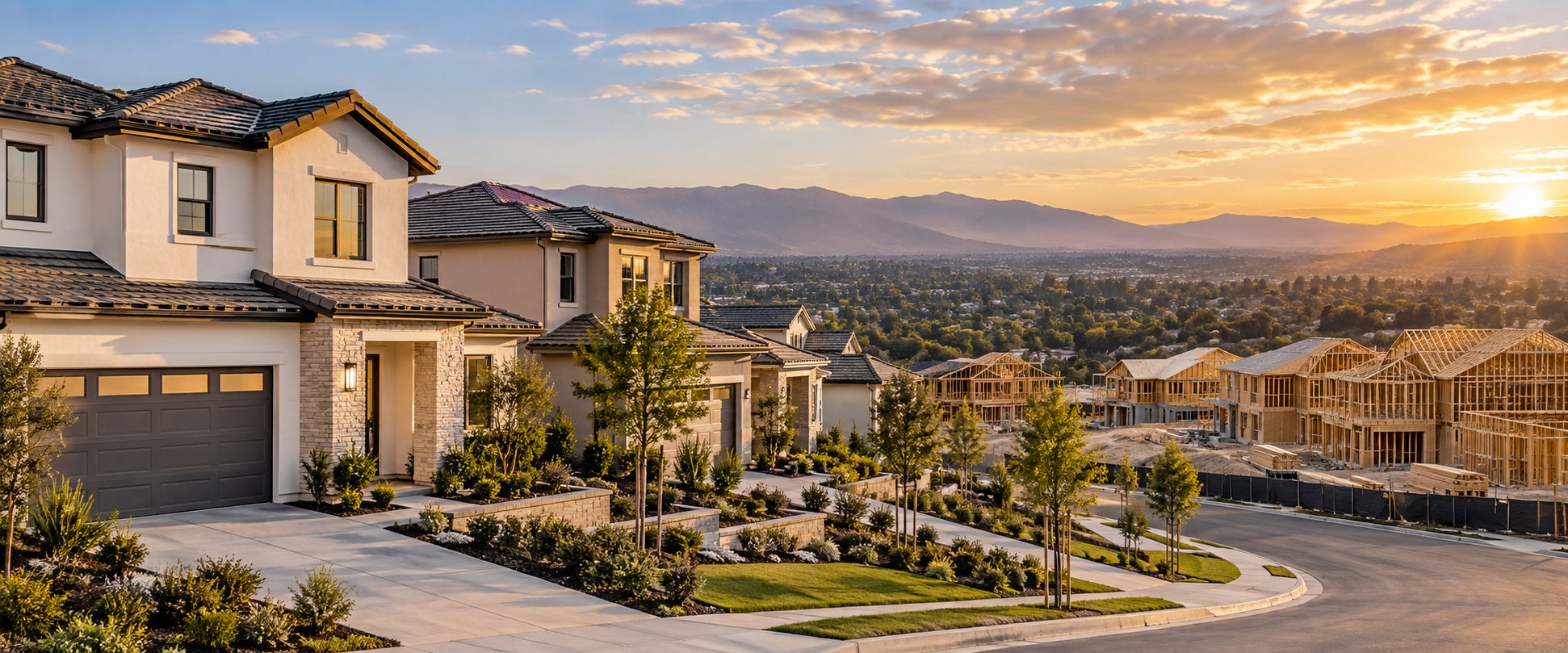
How Prop 37 Would Work
Prop 37 would authorize CalHFA to issue up to $25 billion in revenue bonds to finance what the measure calls a “middle-class homeownership loan.”
An eligible buyer could receive a second mortgage of up to 17% of the home’s purchase price. The buyer would provide at least 3% from their own funds and obtain a separate first mortgage for the remainder.
According to the California Legislative Analyst’s Office, the homeowner’s payments on the second mortgage would be structured to repay the revenue bonds and cover the program’s administrative costs. The measure directs CalHFA to keep borrowing costs as low as possible, but the actual interest rate and repayment terms have not yet been established.
That last point matters when evaluating affordability.
What Would This Look Like on an $800,000 Home?
Consider a hypothetical $800,000 newly constructed home.
With the maximum 17% Prop 37 loan, the financing could look something like this:
Purchase price: $800,000
Buyer contribution at 3%: $24,000
Proposition 37 second mortgage at 17%: $136,000
First mortgage: $640,000
The buyer has put $24,000 into the purchase but has borrowed a total of $776,000.
That’s considerably different from putting 20% down and borrowing $640,000.
The potential advantage is obvious: a household that has the income necessary to afford a home but hasn’t accumulated $160,000 for a 20% down payment could potentially purchase sooner.
The tradeoff is equally important. The buyer still owes the $136,000 second mortgage.
How the Numbers Change at Different Home Prices
The same basic structure can be applied at several price points.
| Home Price | 3% Buyer Contribution | 17% Prop 37 Loan | First Mortgage | Total Borrowed |
| $650,000 | $19,500 | $110,500 | $520,000 | $630,500 |
| $800,000 | $24,000 | $136,000 | $640,000 | $776,000 |
| $1,000,000 | $30,000 | $170,000 | $800,000 | $970,000 |
These examples assume the buyer receives the maximum 17% second mortgage. Actual financing would depend on program requirements, lender qualification and the terms ultimately established by CalHFA.
Who Could Qualify?
Prop 37 would not be limited to first-time homebuyers.
That’s an important distinction from many existing homebuyer assistance programs. A current homeowner who sells and purchases qualifying new construction could potentially participate.
Among the requirements, a buyer would have to:
- Have lived in California for at least one year
• Have household income no greater than 200% of the area’s median income
• Contribute at least 3% of the purchase price
• Occupy the property as a primary residence within 60 days
• Obtain a first mortgage for the remaining financing
CalHFA would also be permitted to establish additional qualification standards, including credit and debt requirements.
Not Every Home Would Qualify
This may be the biggest limitation for buyers shopping the broader Southern California housing market.
Prop 37 is primarily aimed at newly constructed housing, not existing resale homes.
Eligible properties could include newly constructed single-family homes, condominiums and townhouses, as well as certain properties converted from nonresidential to residential use. In general, the participant would have to be the property’s first purchaser.
There are also maximum purchase-price limits that vary by county and are subject to adjustment.
That means a buyer comparing an existing home in Temecula or Murrieta with a newly constructed home nearby could potentially have an additional financing option available on the new home that isn’t available on the resale property.
The Potential Benefit: Getting Past the Down-Payment Barrier
For some households, income isn’t necessarily the biggest obstacle to homeownership. Accumulating the down payment is.
Consider the $800,000 example.
A traditional 20% down payment is $160,000.
Under the maximum Proposition 37 structure, the buyer’s minimum contribution would be $24,000.
That’s a difference of $136,000 in upfront cash.
Of course, that doesn’t mean the buyer has saved $136,000. They have financed it through the second mortgage.
That’s why buyers should separate two questions:
How much cash do I need to buy the home?
and
How much will this home actually cost me each month?
Those aren’t the same question.
What About Putting 5% or 10% Down Instead?
This is where the eventual loan terms will become particularly important.
Buyers already have conventional financing options that can allow purchases with less than 20% down. Depending on the loan and borrower, those options may involve private mortgage insurance and other costs.
A buyer considering Prop 37 would therefore want to compare at least four scenarios:
5% conventional down
Higher first mortgage, potentially with mortgage insurance.
10% conventional down
More cash required, but a smaller mortgage.
20% conventional down
Much more cash required upfront, but a substantially smaller amount financed and typically no private mortgage insurance.
3% buyer contribution plus a Prop 37 second mortgage
Far less cash required upfront, but two loans to repay.
There isn’t one structure that automatically makes the most financial sense for every buyer.
Income, available savings, monthly payment, interest rates, mortgage insurance, how long the buyer expects to own the home and the terms of the second mortgage all matter.
Could Prop 37 Affect New Construction?
Potentially.
One purpose of the measure is to connect homebuyer financing with newly constructed housing. By expanding the pool of buyers capable of financing those homes, the program could potentially encourage additional construction.
But that outcome isn’t guaranteed.
The Legislative Analyst’s Office notes that several important factors remain uncertain, including investor demand for the revenue bonds, the eventual interest rate and terms of the loans, participation by homebuyers and the program’s ultimate effect on home construction and purchasing activity.
Those uncertainties are worth keeping in mind when evaluating the measure.
The Question Buyers Should Be Asking
The most interesting part of Prop 37 from a real estate standpoint isn’t simply whether someone can buy a home with 3% of their own money.
It’s whether the complete financing package makes sense.
For a buyer who earns enough to support homeownership but has been unable to accumulate a large down payment, this type of program could potentially change the equation.
For someone who already has substantial cash available, a conventional mortgage with a larger down payment could ultimately be less expensive.
And for someone who prefers an existing home, Prop 37 generally wouldn’t apply at all.
Until CalHFA establishes the actual interest rate and repayment terms, a meaningful apples-to-apples comparison of the monthly cost can’t be made.
But if Prop 37 passes, that’s exactly the comparison buyers should make before deciding whether to use it.
Sources: California Secretary of State Official Voter Information Guide; California Legislative Analyst’s Office.
This article is intended for general informational purposes and is not an endorsement of or opposition to Proposition 37. Buyers should consult their lender or financial professional regarding financing options and qualification requirements.
